POTS is short for Postural orthostatic tachycardia syndrome.
Postural: position of body
Orthostatic: mobilizing in an upright position
Tachycardia: rapid heart rate out of normal range
It is a condition that affects blood circulation, the autonomic nervous system, and the sympathetic nervous system within your body. These vital functions contribute to your body’s maintenance, long-term health, and direct functioning. The autonomic nervous system is a regulatory system that maintains critical organ systems. The sympathetic nervous system’s primary responsibility is stimulating the fight or flight response.
It is generally marked by sudden lightheadedness, fainting, and a rapid increase in heartbeat when standing up after sitting, leaning back, or laying down. etc.
POTS is a part of a phenomenon known as orthostatic intolerance: The development of symptoms when standing up from a reclining position, which may be alleviated by sitting or lying back down. The main symptom of orthostatic intolerance is lightheadedness, fainting, and a rapid increase in heartbeat.
Blood pressure and heart rate function separately but can affect each other, especially during extremes- when blood pressure is really high and heart rate is meager. POTS dysregulates the normality of blood vessel contraction and heart rate response. This is reflected negatively as unstable blood pressure levels.
Each patient with POTS is different and so is each case. People who have POTS could watch symptoms arise and fall over a period of years. For most POTS cases, with changes in diet, lifestyle, holistic treatment, and physical activity, a person with POTS will experience a positive impact on the quality of their life. POTS can be eliminated if the root underlying cause of the condition is found and treated with care.
The top three most common forms of POTS are:
Neuropathic POTS: Peripheral denervation is a loss of nerve function that leads to poor blood vessel muscles- most prominent in the lower extremities (legs) and core of the body.
Hyperadrenergic POTS: Overactivity of the sympathetic nervous system.
Low blood volume POTS: Reduced blood volume can lead to POTS. Low blood volume can cause similar symptoms that may overlap in neuropathic and hyperadrenergic POTS.
No one knows exactly what causes POTS. Research points to genetic factors. In some cases, autoimmunity was found to be the underlying cause. While heart rate and blood pressure are factors in the symptoms of POTS it hasn’t been linked to any cardiovascular diseases. POTS may be related to chronic fatigue syndrome. (source).
(source)
In addition to these symptoms, a lot of people with POTS experience Gastropesis…
Gastroparesis, also known as delayed gastric emptying, is a condition that decreases or stops the movement of food/nutrients from the stomach to the small intestine. The stomach contracts to break up food and transport it through the gastrointestinal tract, releasing hormones and enzymes as it breaks down and allows for the digestion of food. Gastroparesis can occur when the vagus nerve is damaged, in this case, POTS is associated. Food then moves slower than is normal or healthy from the stomach to the small intestine. Sometimes it stops moving altogether. Patients’ bodies may also undergo malnourishment. Because POTS patients can experience intolerances and reactions to a lot of staple foods, they can lack the ample nutrition they require for their bodies to function.
Electrolytes are important to keeping your nervous system and muscles functioning and your internal environment balanced. Since Boulder Salt is composed of essential electrolytes, it helps to regulate the nervous system in terms of regulating POTS symptoms. Optimizing these benefits means making sure you have the best salt for POTS.
According to Dysautonomia International, “it is often recommended to increase fluid and salt intake to increase blood volume, which is typically low in POTS patients. This has proven to be particularly helpful in patients with blood pooling, hypovolemia, or hypotension.” (source)
One reason people with POTS experience faintness when they stand up is low circulating blood volume. Letting yourself drink more fluids is helpful, but the most important aspect to keeping the fluids in circulation is sodium. The healthiest (and tastiest) way to take in sodium is with the ideal blend of potassium, magnesium, calcium, and bicarbonate. This is far better for you than taking it accompanied by only chloride.
POTS can be treated at home like many other diseases, conditions, and accidents. Healing and treating yourself can be a powerful process that teaches you self-reliance skills. When we heal ourselves we can reconnect with the basic elements that are the building blocks of life.
Boulder Salt recommendation for Postural Orthostatic Tachycardia Syndrome: 4 grams, 1/2tsp (2servings) of Boulder Salt in 20-24oz of water, first thing upon rising. Before your coffee/tea/morning. (bouldersaltcompany.com)
Aerobic exercise and lower limb resistance training can help to circulate blood throughout the body. (source)
Move your hips and thighs to the side…
Bring your knees to 90 degrees, placing your right hand against the outside of your right knee and your left palm on the outside of your left knee.
Bending Hips With Knees Bent…
Bending your left knee 90 degrees, lifting your left thigh while pushing down with your left forearm and hand. Repeat this exercise using your right thigh as the working leg and your right as the resisting arm.
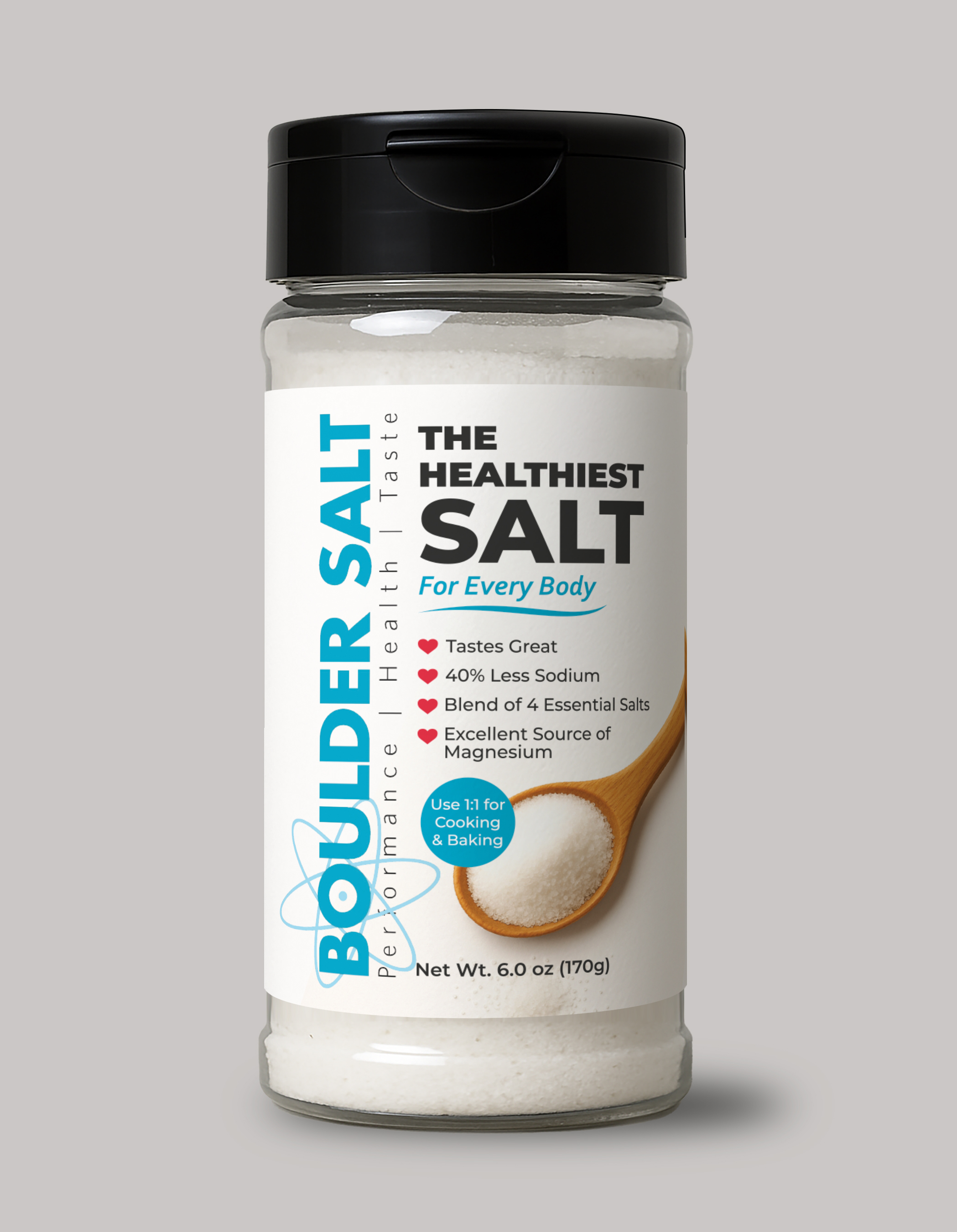
Boulder Salt (bouldersaltcompany.com) is a healthy multi-salt designed with a high nutrient content – unlike your typical table salt, pink salt, and sea salt. Its high nutrient content and ideal ratio of electrolytes make it the best salt for POTS. Yes, intaking sodium is important but the highest quality of salt should be considered when investing in your health. Calcium, Magnesium, and Potassium are the building blocks of life and that’s what Boulder Salt is.
Many people who have POTS need up to three times more sodium than the standard suggested by the US Dietary Guidelines: one teaspoon of salt. You can utilize Boulder Salt (bouldersaltcompany.com) in a variety of ways: from making electrolyte drinks, pickles, olives, broths, brines, and rubs to ways of incorporating lots of yummy salt with high volumes of essential nutrients, Calcium, Magnesium, and Potassium.
“Electrolyte”… is a general description for particles that carry a positive or negative electric charge.
Nutritionally, it is referring to important minerals found in your blood, sweat, and urine.
When the minerals dissolve in fluid, they make electrolytes — positive or negative ions used to carry out metabolic processes.
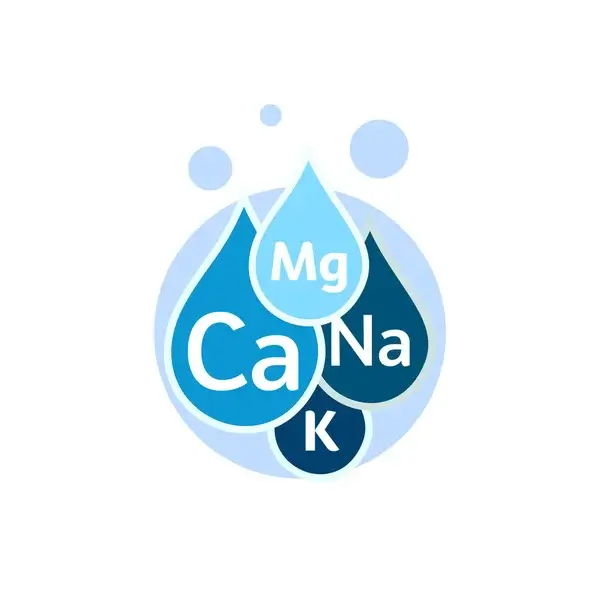
Electrolytes that are in your body are:
These electrolytes are required for various bodily processes, including correct nerve and muscle function, maintaining acid-base balance, and keeping you fully hydrated!
Boulder Salt (bouldersaltcompany.com) contains these electrolytes in the ideal ratio, in the form of a highly nutritious salt.

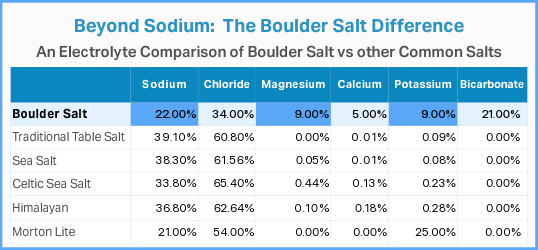
Most performance related salt products on the market are close to 100% sodium. Our bodies need a variety of electrolytes to perform at optimal levels – not just sodium. Boulder Salt provides a robust, alkaline blend of electrolytes, including sodium, potassium, magnesium and calcium. And in a combination that approximates what should naturally exist in the body. This ratio can help athletes optimize their performance.
It varies depending on your activity level and sweat rate. In general 4 servings is common for everyday use, up to 6 servings for endurance athletes.
If you are under the care of a physician for a medical condition, consult your doctor first.
Boulder Salt is unique in that it can be taken alone, added to water, or mixed with other beverages to up their electrolyte value. It also gives you the option to make your own sports drink – adding flavors and/or sweeteners that work for you.
Yes. If you’re looking to enhance your electrolyte levels, Boulder Salt® is an ideal way to do so! It can be added to both water and sports drinks. You will likely be surprised at how mellow it tastes in water alone. And it will not significantly alter the taste of most beverages. However, Boulder Salt is alkaline, so if you add it to an acidic sports drink (which many are), you can expect to see the drink temporarily “bubble” or foam-up.
Athletes have used Boulder Salt® during all phases of a competitive event – whenever they are accustomed to drinking water or another sports drink. It’s balanced level of electrolytes make it an ideal addition to your electrolyte replacement regime. It can help you shore up electrolytes, hydrate quickly and help prevent or eliminate cramping.
If you are undergoing treatment for a medical condition, consult your physician.
Boulder Salt® is a soft, mellow-tasting salt. The varying size and shapes of different salts provide a unique taste experience. The tiny calcium and magnesium salts, which are very mild tasting, cover the surface of the sodium and potassium crystals and provide for a mellowing of the familiar “bite” of those salts.

Yes. Boulder Salt® has nearly ½ the sodium per serving than traditional table salt. And it has a ratio of potassium to sodium, that helps the body maintain a healthy blood pressure.
YES! Boulder Salt® is much lower in sodium chloride than traditional table salt , sea salt, and Himalayan pink salt – which are all over 95% sodium, making Boulder Salt a much healthier alternative!
Alkalinizing the body means means shifting your body from an acidic state to a more neutral or alkaline state. Our normal state of being should ideally be slightly alkaline.
However, environmental factors, stress, a diet low in fruits and vegetables or high in meats and other processed foods, and especially carbonated drinks, can all push our systems into an acidic state. When your body is closer to an alkaline state, you’ll experience fewer illnesses, be better prepared to fight off disease, and simply feel better. Unlike traditional table sale and sea salt, Boulder Salt® is alkaline.
Absolutely! Boulder Salt® can be used as a 1:1 replacement for any other salt in food preparation, baking and cooking.
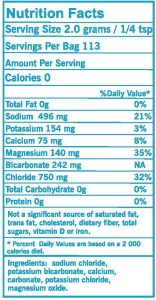
Boulder Salt® looks different from other salts due to the fact that it is made up of a variety of salts, rather than just one type. Both the chemical composition as well as the particle sizes of the various salts used in Boulder Salt® are different. If you looked under a microscope, you’d see that some of the salts look like “boulders”, while others are much smaller.
Boulder Salt® is a blend of naturally occurring salts including sodium, potassium, magnesium, and calcium , which are all critical on a biological level.
The ingredients in Boulder Salt are chosen based on purity, not location. We take 4 different salts and blend them together in a particular ratio to make Boulder Salt. We only use pharmaceutical grade or USP grade salts.
1/4 Teaspoon of “regular salt” weighs 1.5g while 1/4 Teaspoon of Boulder Salt weights 2.0g (more dense). Once this difference in density is taken into account, the 40% difference can be shown. For example: A typical brand of salt shows 585 mg. of sodium in 1/4 tsp. (1.5g).
The sodium in 2.0g is given by 585 x 4/3 = 780mg How much less sodium is in Boulder Salt is given by: 780-480=300 300/780 = .385 or 38.5% less (rounds to 40%)
Boulder Salt has nearly half the sodium of traditional table salt and sea salt. It also has potassium, magnesium and calcium – salts that are all critical on a biological level. (Traditional table salt is 99% sodium). Boulder Salt looks a bit different too, It has a finer texture than most other salts on the market and a more mellow taste.
The precise amount of Boulder Salt® to add to your drink depends on your sweat rate. One quarter teaspoon in a 17-20 oz drink is the recommended starting point.
The material you see that doesn’t dissolve is related the larger particle size of magnesium and calcium. It’s around 4% of the total. These particles do readily dissolve when they are exposed to an acidic environment such as in the stomach. They will dissolve right away if you keep them agitated/stirred up and drink the water with them suspended in it.
Boulder Salt® looks different from other salts due to the fact that it is made up of a variety of salts, rather than just one type. Both the chemical composition as well as the particle size of the various salts used in Boulder Salt® are different. If you looked under a microscope, you’d see that some of the salts look like “boulders”, while others are much smaller.
We do plan to offer our product in the future, with iodine. Our current formulation does not have iodine because it tends to have a metallic taste when added to water. If used simply on foods, it does not have that strong of an aftertaste. The current formula of Boulder Salt® is intended to be used in both water and on food.
Boulder Salt® is available here on our website, on Amazon, and in several states including California, Colorado, Hawaii – Kona, Massachusetts.
We currently ship to Australia, Canada and New Zealand.